Timeline
Research milestones, hardware generations, model releases, industry build-outs and policy turns: with links into the records they concern.
1990–2011 · The long ramp
NVIDIA opens its GPUs to general computation: the platform deep learning will land on.
2012–2016 · Deep learning works
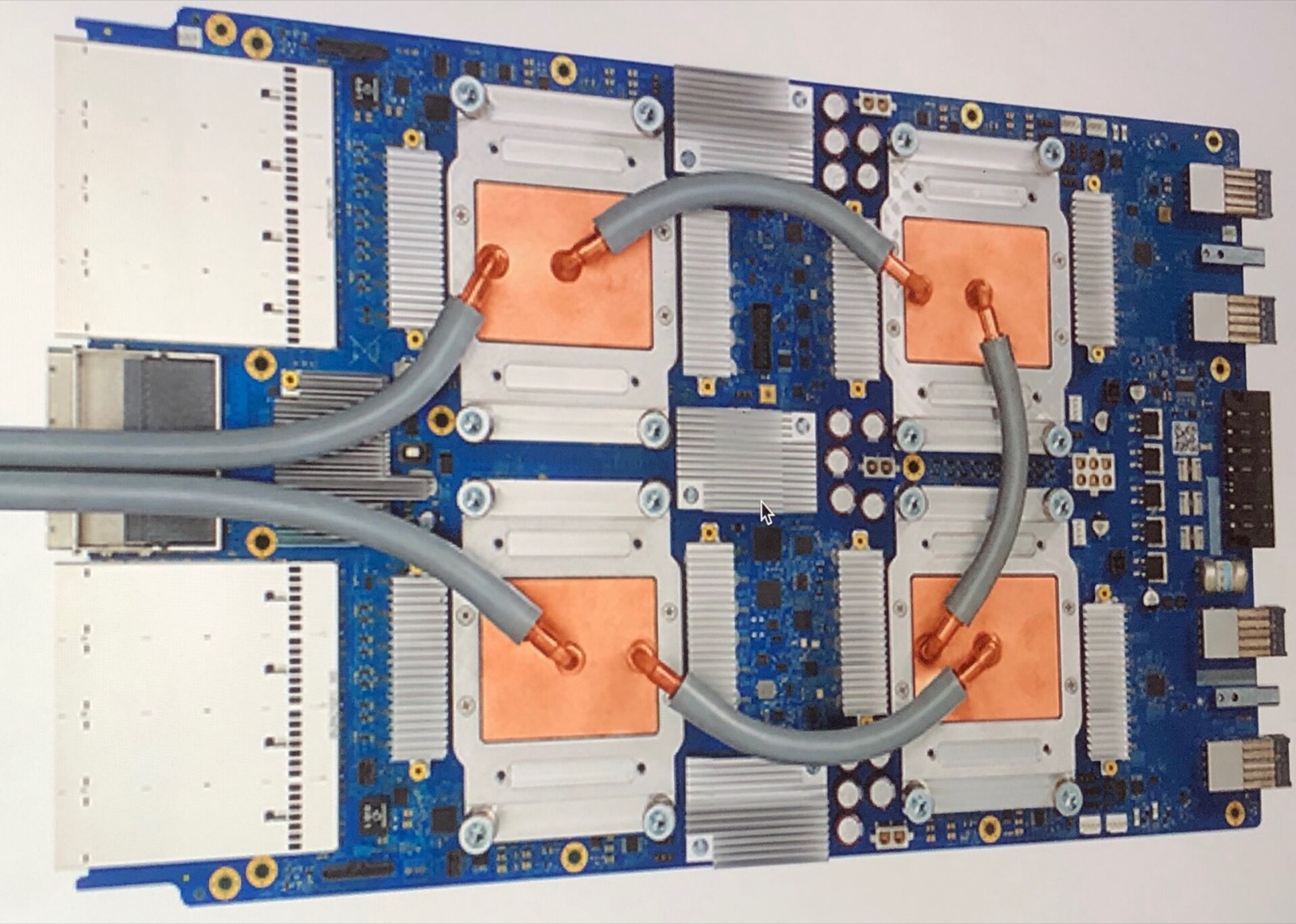
A 15-month crash ASIC project puts custom inference silicon in production: revealed to the world in 2016.

2017–2019 · Transformers
NVIDIA builds matrix math into silicon: the first AI-specific GPU feature.
2020–2022 · Scaling
2023–present · The build-out
Two-die B200 and the GB200 NVL72 make the rack the unit of computing, and liquid cooling mandatory.
1.742 exaFLOPS on AMD MI300A: the public sector's biggest disclosed machine.
AWS commits its own silicon to Anthropic at hundred-thousand-chip scale.
Google's inference flagship: 9,216-chip pods for the 'age of inference'.
AMD's CDNA4 reaches Blackwell class; OpenAI appears on stage.
NVIDIA unveils the six-chip Rubin platform, says it is in full production, and targets partner systems for the second half of 2026.
A 3 nm inference accelerator with 216 GB of HBM3E and over 10 PFLOPS of FP4, already serving Copilot and OpenAI models in Azure.
Huawei's new accelerator ships on the Atlas 350 card with in-house HBM; Reuters reports a target of about 750,000 chips in 2026.
The eighth generation arrives as two chips, TPU 8t for training and TPU 8i for inference (vendor claims), as Ironwood becomes generally available.
Inference racks built on technology licensed from Groq in December 2025 reach full production, with Nebius as the first cloud adopter.
The transformer-ASIC startup delivers its first rack to Jane Street and raises $700M at a $21B valuation.
NVIDIA says production shipments of Vera Rubin began in August 2026.
CoreWeave offers Vera Rubin NVL72 with Cognition as the first production customer; Oracle Cloud declares general availability on October 27.
An HBM4 accelerator on TSMC N2P, which Microsoft says will scale to multi-gigawatt deployments as its primary inference system from 2027.