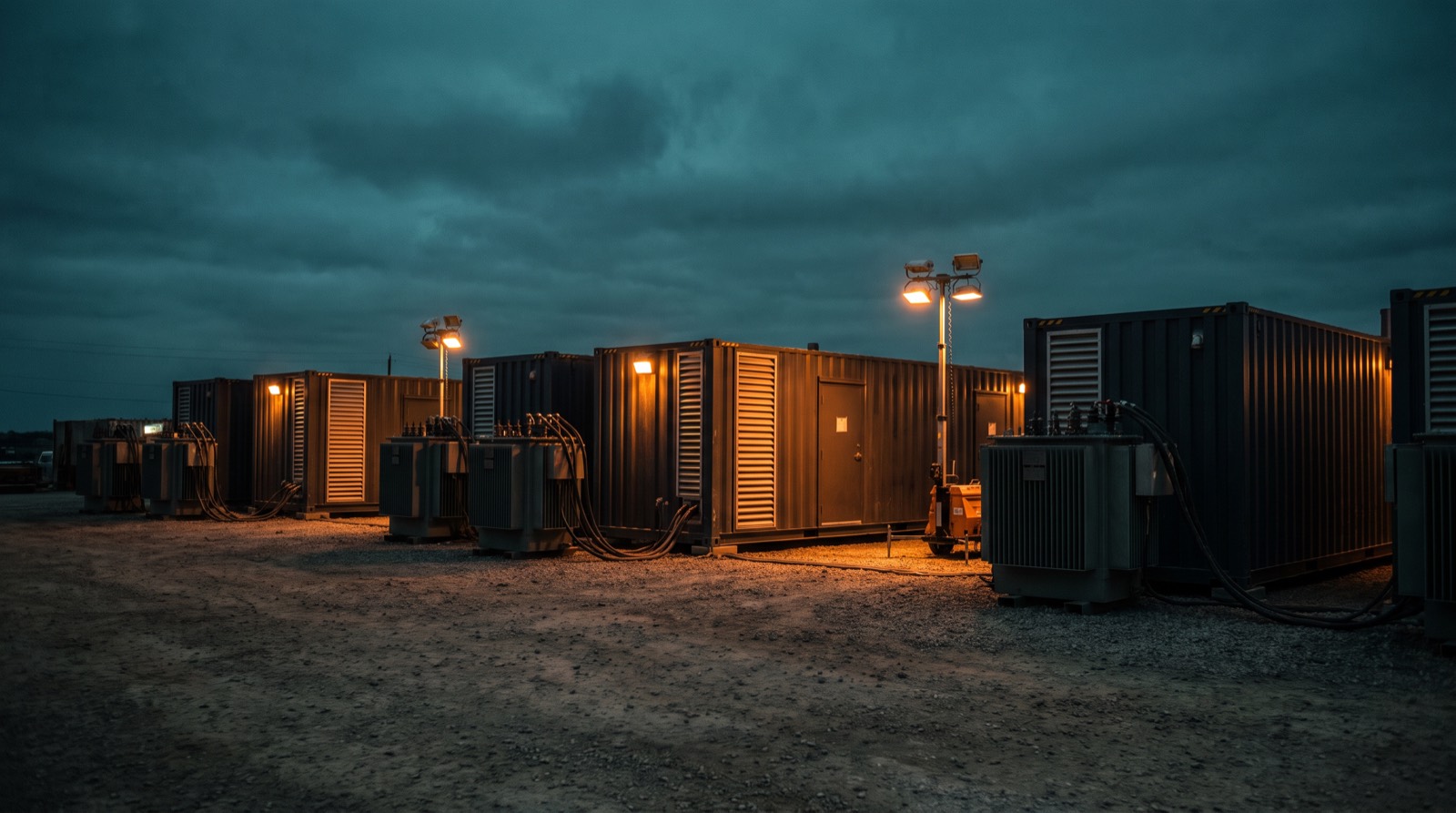
For thirty years data centers were air-conditioned buildings. Blackwell ended that: a 120 kW rack cannot be cooled with fans, full stop. The resulting retrofit-and-rebuild wave is one of the biggest industrial stories in this database.
The physics
Air is a terrible coolant — low heat capacity, low density. Past roughly 40–50 kW per rack, moving enough of it means hurricane fans eating double-digit percent of the power budget and still failing at the chip: a 1,000+ W die needs its heat pulled off a few square centimeters, and only liquid contact does that. Water carries ~4,000x more heat per volume than air.
The mainstream answer: cold plates
Direct-to-chip cooling bolts a machined copper plate with microchannels onto every GPU, CPU and switch ASIC. Treated water (or glycol mix) flows through rack manifolds to a coolant distribution unit, which exchanges heat into the facility loop while keeping the chip loop clean and leak-monitored. GB200 NVL72 made this mandatory equipment; every OEM ( Supermicro, Dell) and specialist (Vertiv, CoolIT, Boyd, Motivair) now ships the chain, and rear-door heat exchangers bridge older halls.
The frontier: immersion and beyond
Immersion — servers submerged in dielectric fluid — handles any density and deletes fans entirely, but serviceability and fluid chemistry (PFAS concerns for two-phase) keep it niche while cold plates work. Microfluidics — channels etched into the silicon itself, which Microsoft demonstrated in 2025 — is the logical endpoint: coolant inside the chip.
Second-order effects
Liquid cooling cut cooling's energy overhead (PUE toward ~1.1), enabled waste-heat reuse (Nordic campuses warm districts with it), and changed water politics — closed loops like Fairwater's fill once, answering the headlines about thirsty data centers. It also minted a stock-market sector: the cooling and thermal names on our Stocks page barely existed as an AI category in 2022.
 7
7